 Loreweaver
✦ Guides
How to build a bard: the character who makes everyone else's turn better
Updated: 2026-05-12
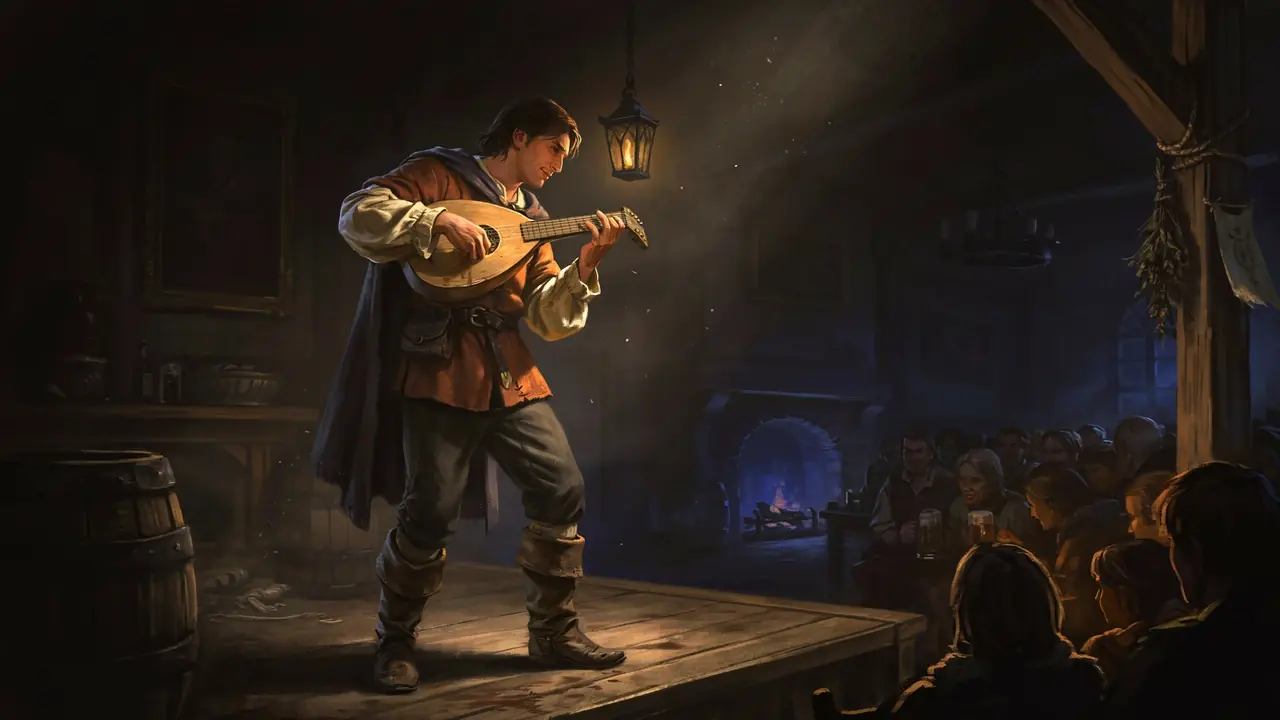
Who the bard is at the table
Every other class answers the question "what do you do?" The bard answers "what does everyone else get to do now that I'm here?" Bardic Inspiration (a die you hand to an ally as a bonus action, which they add to an attack roll, ability check, or saving throw within the next ten minutes) is the truest class feature in the game, because it makes your power legible only through other people. The fighter lands the impossible blow because of you. The wizard's concentration holds because of you. You are the reason the story went well, and almost nobody rolls the dice to prove it.
The performer is only the costume this class ships in. Underneath, the bard is anyone whose weapon is attention: the lawyer who has never lost when the jury could see her face, the disgraced court tutor who knows which noble houses owe which debts, the con artist working his way toward one honest thing. Music explains the magic; it doesn't cause it. What causes it is the character's conviction that the right words, at the right moment, change what's possible, and the sheet agrees.
Two proficiency quirks make the point mechanically. The bard picks three skills from the entire skill list (the only Loreweaver class with no shortlist at all) and learns three musical instruments, which tells you the class's idea of a toolbox is "whatever the room requires."
The choices that matter, level by level
Level 1 hands you the game's most consequential shopping trip: two cantrips and four known spells, cast with Charisma. Known is the operative word: unlike a cleric, you can't rewrite this list each morning, so every pick is semi-permanent and should earn its slot. The reliable frame: one way to hurt (Vicious Mockery doubles as flavour and debuff), one way to save someone (Healing Word is a bonus action at 60 feet, which is the difference between healing and rescuing), one way to control a fight (Sleep or Faerie Fire), and one spell that is purely your character (Charm Person for the charmer, Disguise Self for the fugitive, Hideous Laughter for the heckler). Ability order is settled: Charisma first, then Dexterity for AC in the light armour that's all you'll ever wear.
Level 2 makes you the party's utility layer. Jack of All Trades adds half your proficiency bonus to every ability check you're not proficient in, which quietly means there is no roll at the table you're bad at. Song of Rest sweetens every short rest for the whole party.
Level 3 is the bard's biggest single level. Your college arrives: Loreweaver builds the College of Lore, which hands you three more skills of your choice and Cutting Words, a reaction that spends an Inspiration die to subtract from an enemy's attack, check, or damage. The same level brings Expertise: pick two proficient skills and double your bonus. Between the college's three skills, your three class picks, and Expertise, a level 3 Lore bard can be proficient in more skills than some entire parties, with two of them at expert level. Level 4 is the first Ability Score Improvement (Charisma, almost always) plus a third cantrip. Level 5 turns the engine over: your Inspiration die grows from a d6 to a d8, and Font of Inspiration refreshes every use on a short rest: the moment generosity stops needing rationing.
Three build sketches
The understudy. A half-elf who spent ten years as the famous soprano's assistant (carrying her scores, learning her repertoire, watching her take the bows) and finally walked out mid-season. Half-elf is the skill build perfected: +2 Charisma, two floating +1s (Dexterity and Constitution), and two bonus skills on top of the bard's three, the college's three, and the Entertainer background's two. By level 3 she is provably good at more things than the diva ever was. Put Expertise into Performance and Persuasion, and let Cutting Words be the reflex of someone who has heard every excuse in the business.
The devil's advocate. A tiefling contract-lawyer who found that infernal ancestry is a liability in every courtroom except the negotiating table, built for control. Tiefling's +2 Charisma and fire resistance suit someone used to hostile rooms; the Charlatan background's Deception and false-identity feature suit someone whose case files don't all use the same name. Spells lean on the mind: Charm Person and Sleep at 1, Hold Person at 3, Hypnotic Pattern at 5, by which point Font of Inspiration means every short rest refills the dice he spends keeping hostile witnesses off-balance.
The kingmaker's daughter. A lightfoot halfling noble (yes, halfling gentry) raised on the principle that small houses survive by knowing things first. +2 Dexterity and +1 Charisma make her hard to hit and easy to believe; Naturally Stealthy means she can vanish behind literally any human at the party. The Noble background brings History and Persuasion; class and college picks go to Insight, Investigation, and Perception, with Expertise in Insight. She fights only as a last resort (rapier and Healing Word), because her actual weapon is knowing which of the six people in the room is lying.
Common traps
The most expensive trap is hoarding Bardic Inspiration. Before level 5 you get Charisma-modifier uses per long rest and no refund, and new bards save them for a perfect moment that never announces itself, then finish the day with three dice unspent. The correction is a rule of thumb, not a calculation: a d6 handed out early shapes the fight; a d6 in your pocket at the end of it shaped nothing. From level 5, when Font of Inspiration refreshes them on a short rest, hoarding stops being thrift and becomes pure waste.
The second trap is building the bard as a discount blaster. The bard's known-spell budget is small and its list is thin on raw damage on purpose; four picks spent chasing damage buys you a worse sorcerer and throws away the class's actual leverage, which is making enemy turns fail and ally turns succeed. If your level 1 list has no answer to "a friend is bleeding out forty feet away," respec before it matters.
The third is treating the rapier as a fighting style rather than an apology. Proficiency with a duelling sword and light armour on a d8 hit die makes you competent at self-defence, not a front-liner; the sword is for the round when the enemy has made the mistake of reaching you. Position like the target you are, and let Cutting Words, not your AC, be the reason attacks miss.
Taking it past level 5
The bard's later levels are a widening of jurisdiction. At 6, Countercharm protects the whole party's minds, and the Lore college's Additional Magical Secrets arrives four levels before anyone else's: two spells from any class's list, free of your known-spells budget. At 10, the main Magical Secrets feature begins (two more any-list picks then, and again at 14 and 18) while Expertise doubles to four skills and the Inspiration die hits d10 on its way to d12 at 15. This is the class's endgame thesis: the bard who has heard every song eventually knows every trick, and by the final tier your spell list is a scrapbook of everything the campaign taught you. Superior Inspiration at 20 closes the loop with a small, perfect promise: roll initiative with an empty pocket and one die comes back. The show always has an opening number.