 Loreweaver
✦ Guides
How to build a cleric: the armoured caster who decides who gets to live
Updated: 2026-05-19
Who the cleric is at the table
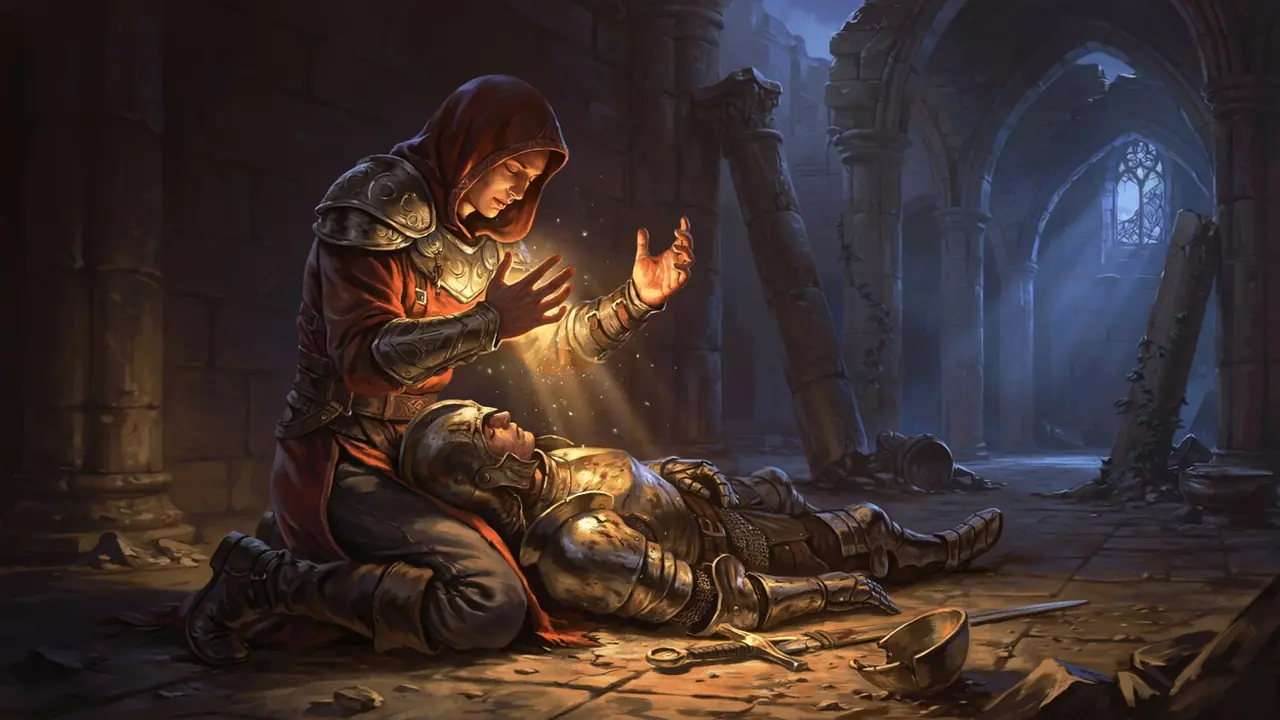
The cleric is the class other characters are glad exists and rarely want to argue with. Mechanically it's an outlier twice over: the only full caster that expects to stand in the front line (medium armour, a shield, and a mace come standard) and a caster whose spell list is not a personal style but a portfolio of authority: blessing, restoration, judgement, and the specific, load-bearing power to reverse death. Whatever the rest of the party does, the cleric decides how much of it is survivable.
The costume is a priest; the character underneath is anyone who answers to something bigger than the party. A battlefield medic who made a promise over a dying friend and heard something promise back. A bureaucrat of a temple hierarchy discovering, far from the archive, that the god is real and has opinions. A grave-digger whose quiet deal with death is that it takes no one early on his watch. The class doesn't require piety as personality; it requires a relationship, and relationships have tension. The most interesting clerics are the ones who sometimes disagree with the being underwriting their power.
Even the skill list is pastoral: Insight, Medicine, Religion, History, Persuasion. You are the party's conscience, chaplain, and negotiator: the one who reads people because souls are the job.
The choices that matter, level by level
The cleric's defining choice lands immediately: your Divine Domain arrives at level 1, not level 3 like a barbarian's path or a bard's college. You know who your character serves before their first fight. Loreweaver builds the Life Domain, and it front-loads generously: proficiency in heavy armour, Disciple of Life adding 2-plus-spell-level extra healing every time you heal, and Bless and Cure Wounds always prepared, free of your daily budget.
That daily budget is the class's real engine, and it's worth understanding on day one. Clerics prepare spells: each morning you assemble Wisdom-modifier-plus-cleric-level spells from the entire cleric list, plus three cantrips you know permanently (Sacred Flame for damage, Guidance for everything else, and Thaumaturgy if you want your sermons to rattle windows). A bard who picks a dud spell lives with it; a cleric who picks a dud spell apologises to no one and swaps it after breakfast. This means you're allowed to prepare weird (Detect Magic on the day you visit the wizard's estate sale) because tomorrow the slot comes back.
Level 2 delivers Channel Divinity, once per short or long rest, in two flavours: Turn Undead, which routs the shambling dead outright, and the Life Domain's Preserve Life, which divides five-times-your-level hit points among wounded allies as a single action: triage as a miracle. Level 3 unlocks second-level slots and adds Lesser Restoration and Spiritual Weapon to your always-prepared list; Spiritual Weapon in particular is a bonus-action floating strike that costs no concentration, and it quietly defines mid-level cleric turns. Level 4 is your first Ability Score Improvement (Wisdom, which raises your save DC, your healing, and your prepared-spell count all at once) plus a fourth cantrip. Level 5 is the summit of the early game: third-level slots bring Spirit Guardians, Beacon of Hope and Revivify join the free list, and Destroy Undead starts disintegrating weaker undead that fail against your Turn.
Three build sketches
The mountain chaplain. A hill dwarf who tended a mining town's shrine for forty years and left only when the mine woke something that ate three parishioners. Hill dwarf is the durability pick made in heaven: +1 Wisdom, +2 Constitution, poison resistance, and Dwarven Toughness adding a hit point every level; stack that on the domain's heavy armour and Preserve Life and you have a healer who simply refuses to be the one who drops. Acolyte is the obvious background and the right one; Insight and Religion say this character has heard ten thousand confessions and believed about half.
The war-priest. A human veteran (Soldier background, Athletics and Intimidation) who buried too many friends on the strength of officers' promises and now marches with the only commander she trusts. Human +1s across the board suit a cleric who wants Wisdom, Constitution, and enough Strength to mean the mace. Her mornings lean martial: Bless (from the free list) for the charge, Shield of Faith for the point man, Spiritual Weapon from 3 so every bonus action lands somewhere, Spirit Guardians from 5 so the enemy pays rent to stand near her.
The hedge-healer. A wood elf Hermit who spent a decade alone in the fens and came back speaking of the god in the reeds, nobody's idea of clergy. +2 Dexterity fills scale mail's allowance exactly while +1 Wisdom feeds the casting; Medicine and Religion from the Hermit background arrive with a discovery no temple has vetted. She prepares like a naturalist (Guidance on everything, Healing Word so rescue works at sixty feet, Lesser Restoration because the fens teach you what disease does), and her Turn Undead reads less like liturgy than like the marsh itself objecting.
Common traps
The classic trap is playing the healing as a subscription: Cure Wounds every round on whoever is scratched. Five-edition arithmetic is unsentimental: enemies deal damage faster than level-matched healing restores it, so a cleric who only heals is losing a race on purpose. The stronger loop is prevention and rescue: Bless (always prepared, and it's three allies' hit rate and saves for a full minute) to make the fight shorter, then Healing Word (a bonus action, at range) to stand the fallen back up at the moment it matters. Disciple of Life makes even that one-die rescue meaningfully bigger. Heal to interrupt death, not to tidy the ledger.
The second trap is concentration collisions. Bless, Shield of Faith, and Spirit Guardians all demand concentration, and no cleric runs more than one at a time; a build that stacks concentration spells is a build with two-thirds of its power imaginary. This is exactly why Spiritual Weapon earns its always-prepared slot at 3: it's the rare damage that runs alongside whichever aura you're holding.
The third is dumping the body. A first-line cleric with 8 Strength in scale mail, or 8 Constitution holding Spirit Guardians, undoes the class's armoured-caster premise: every hit you take rolls against the concentration keeping your best spell alive. After Wisdom, put real points in Constitution and respect what the shield is for.
Taking it past level 5
The Life cleric's later arc bends toward the miraculous. Blessed Healer at 6 completes the circuit (healing others starts healing you), and a second Channel Divinity use per rest doubles your triage. Divine Strike at 8 wraps the mace in radiant damage, a reminder that this remains a front-line class. Then the ceiling opens: Divine Intervention at 10 lets you spend an action asking your god to handle it personally, succeeding on a percentile roll at or under your cleric level: a literal deus ex machina you can attempt daily until it works, and once it works, a seven-day silence that is its own storytelling. The free spell list has been escalating all the while, from Death Ward through Raise Dead, until Supreme Healing at 17 stops rolling healing dice and simply takes the maximum. At 20 the intervention no longer requires a roll: call, and the god answers, every time. The character arc is written into the math: a whole career spent proving you only ask when it matters, ending with the answer guaranteed.