 Loreweaver
✦ Guides
How to build a druid: the wild as a toolkit, levels 1 to 5 and beyond
Updated: 2026-05-26
Who the druid is at the table
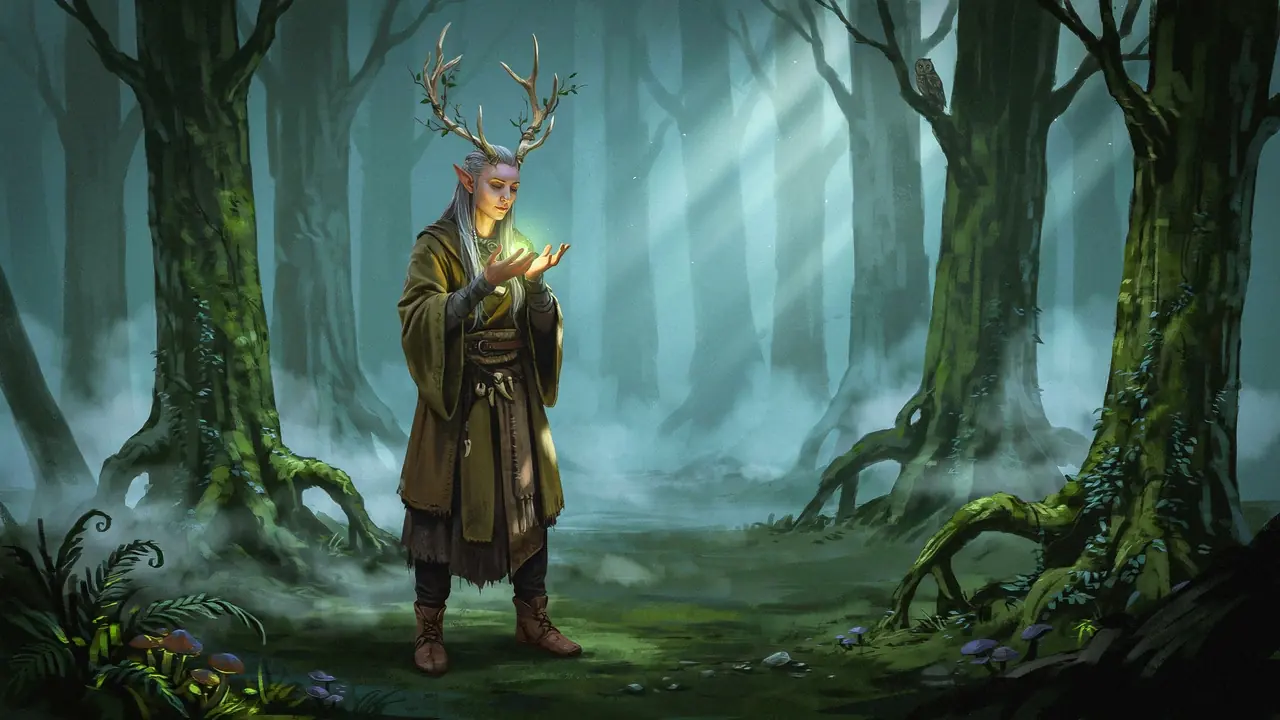
Every other spellcaster's magic has a source you could point to: a god, a book, a bloodline, a bargain. The druid's source is the weather. Their power comes from standing in a relationship with the living world, and the sheet reflects it everywhere: spells prepared fresh each morning like a forager's basket, a secret language (Druidic) that only other druids can read, an herbalism kit, and, from level 2, the ability to stop being a person for a while and be an animal instead. Wisdom runs all of it, which tells you who this character is before you write a word: someone who pays attention.
The archetypes are wider than the robes-and-sickle picture. A hedge-healer who serves six villages that share one road and no doctor. A borderland warden who has spent so long watching a forest that the forest has started watching back. A retired ship's pilot who learned to read water the hard way and came ashore when the sea stopped answering. What they share is a jurisdiction (some patch of the world they consider theirs to keep), and the game's job is to threaten it.
The skill list backs this up: your two picks come from a menu of noticing and knowing: Perception, Survival, Nature, Medicine, Insight, Animal Handling, Arcana, Religion. And the starting kit tells its own quiet story: leather armour, a quarterstaff, a wooden shield, a druidic focus. Nothing on the character needed a forge.
The choices that matter, level by level
At level 1 the decision is your ability order, and it's short: Wisdom first, because it powers every spell you cast and every save you force; Constitution second, because a d8 hit die in leather needs the help and so do your concentration checks; Dexterity third for the armour class. Then learn the class's real rhythm: preparation. Each morning you prepare a number of spells equal to your Wisdom modifier plus your druid level, chosen from the entire druid list. A level 1 druid with 16 Wisdom preps four. That number is small; the list behind it is not, and being able to re-pick it every day is the class's quietest superpower. Ritual casting sweetens it further: rituals like Detect Magic can be cast slow and free without spending a slot.
Level 2 is the biggest single level the class gets, because two things land at once. Wild Shape lets you spend an action to become a beast of challenge rating 1/4 or lower (no flying or swimming forms yet) twice per short or long rest. And your Druid Circle arrives, a full level earlier than most classes commit to a subclass. The circle Loreweaver builds today is the Circle of the Land: a bonus cantrip, and Natural Recovery, which once a day lets a short rest hand back spell slots totalling half your druid level, rounded up. You also choose your land (eight terrains, from Arctic to Underdark), and from level 3 that choice starts paying out circle spells that are always prepared and never count against your daily number. A Forest druid gets Barkskin and Spider Climb; a Grassland druid gets Invisibility and Pass Without Trace. The terrain is a backstory decision with a spell table attached.
Level 4 brings your first Ability Score Improvement (for most druids, +2 Wisdom, no agonising) plus a third cantrip and a better Wild Shape: challenge rating 1/2, and swimming forms are now allowed. Level 5 is the full-caster payoff: 3rd-level slots, which on the druid list means Call Lightning and Conjure Animals, the moment the sky and the wildlife both start taking your side in a fight.
Three build sketches
The last doctor on the mountain. A hill dwarf who spent thirty years as a hermit in the high passes and came down when the passes started killing more travellers than the winters used to. Hill dwarf is quietly the toughest druid chassis in the game: +2 Constitution, +1 Wisdom, and Dwarven Toughness adding a hit point every level, which turns the d8 hit die from a worry into a rounding error. The Hermit background brings Medicine and Religion; take Nature and Perception from the class list, choose Mountain as your land, and by level 5 you're the healer who can also answer an avalanche with Lightning Bolt, a spell no other druid gets.
The long-strider. A wood elf courier who carries word between settlements that maps pretend are adjacent, built for the Grassland circle. The wood elf's +2 Dexterity and +1 Wisdom shore up exactly the druid's second and first priorities, 35 feet of speed makes the courier concept literal, and Mask of the Wild lets you vanish in light natural cover. Outlander adds Athletics and Survival and a wanderer's memory for terrain. From level 3, Grassland hands you Invisibility and Pass Without Trace always-prepared: the entire job description, written in spell slots.
The wise-woman of the weir. A human raised in a river village that has consulted her family about floods, fevers, and missing children for four generations. Human's +1 to every ability suits a druid who genuinely uses five of them, Folk Hero brings Animal Handling and Survival plus a welcome at every common hearth, and the Forest circle fits a life lived under the same canopy: Barkskin and Spider Climb at 3, Call Lightning and Plant Growth by 5. She's not an adventurer who knows nature. She's the person the adventurers get sent to.
Common traps
The first trap is treating Wild Shape as your attack plan. At level 2 it's two uses per rest, capped at challenge rating 1/4, with no flying or swimming forms; a wolf is a fine set of teeth at level 2 and an obsolete one by level 5, when your 3rd-level slots outfight any beast you can become. Wild Shape's real cargo is everything else: a scout nobody looks at twice, a pack mule, an escape through a gap no human fits, and a spare pool of hit points when things go wrong. Spend it on being somewhere you shouldn't be, not on damage you could have cast.
The second trap is preparing the same spells every morning. Do that and you've paid the prepared-caster tax (the daily bookkeeping) without collecting the prepared-caster refund, which is fitting the list to the day. Heading underground? Swap the charm for Fog Cloud. Long march, short rations? Goodberry earns its slot. The druid who preps by habit is a worse sorcerer; the druid who preps by forecast is the most flexible caster at the table.
The third trap is neglecting Constitution because Wisdom does the casting. Nearly all of the druid's best table-tilting spells (Entangle, Moonbeam, Call Lightning among them) require concentration, and concentration breaks on failed Constitution saves when you take hits, which in leather armour you will. A druid who dumps Constitution isn't a glass cannon; they're a glass weather vane, and every goblin with a sling gets a vote on whether your storm stays up.
Taking it past level 5
The druid's later arc is the world gradually forgetting you were ever separate from it. Land's Stride at 6 lets you move through difficult terrain and hostile undergrowth as if the wilderness had simply agreed to stop applying to you. Wild Shape hits challenge rating 1 at level 8 and sheds its last movement restrictions: the sky and the sea open. Nature's Ward at 10 makes you immune to poison and disease and proof against the charms and terrors of elementals and fey, and Nature's Sanctuary at 14 means beasts and plants must fight their own instincts to raise a claw against you. Then level 18 lands the class's two most transformative lines at once: Timeless Body slows your aging to a tenth, and Beast Spells lets you cast in animal form: the wolf can finally call the lightning. Archdruid at 20 removes the limits entirely: unlimited Wild Shape and spellcasting freed from its components. The arc ends where the story was always pointing: not a person who visits the wild, but a piece of the wild that occasionally remembers how to be a person.