 Loreweaver
✦ Guides
How to build a monk: speed, ki, and the empty hand, levels 1 to 5 and beyond
Updated: 2026-06-09
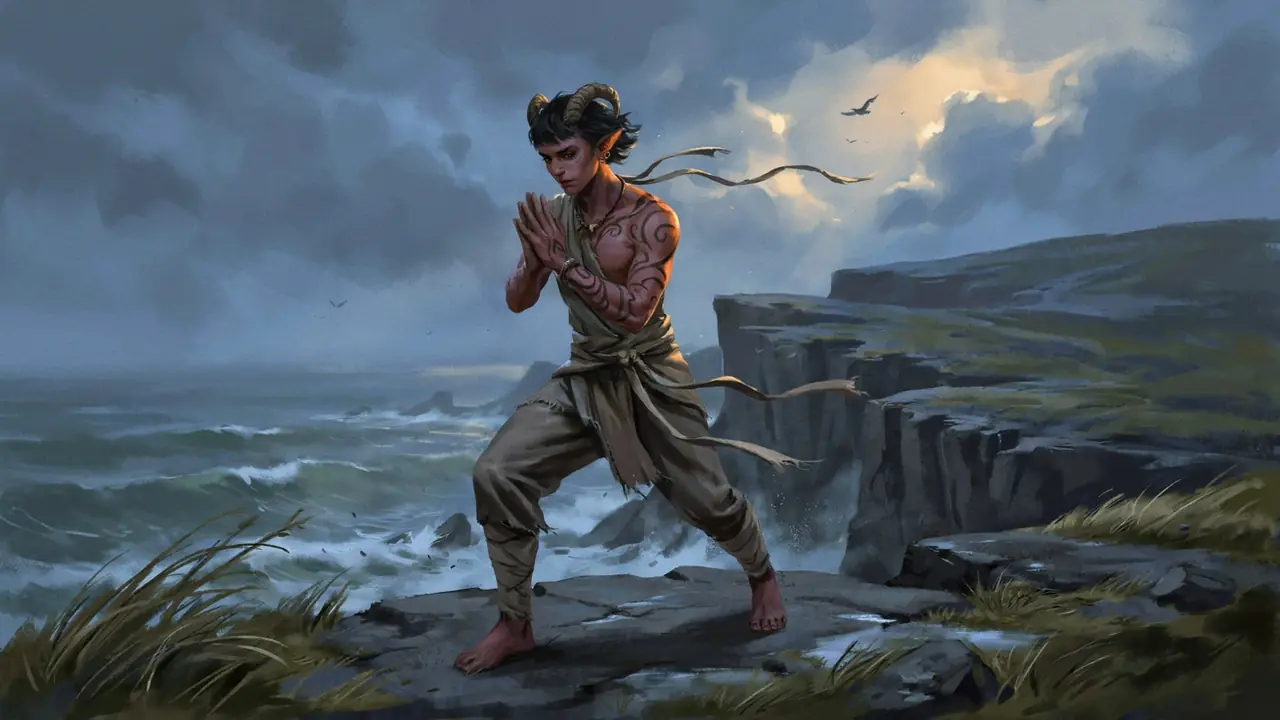
Who the monk is at the table
Every other martial class solves violence with equipment. The monk solves it with practice, and the sheet is almost defiant about it: no armour proficiency at all, weapon training that stops at simple weapons and shortswords, and in exchange, a body that does everything the gear was for. Unarmored Defense builds your AC from 10 plus both your Dexterity and Wisdom modifiers. Martial Arts lets Dexterity power your unarmed strikes and monk weapons, gives your bare hands a damage die, and hands you a bonus-action punch after every Attack action. The monk hasn't rejected weapons out of poverty. The monk has concluded, after long study, that weapons are a crutch, and the rules agree.
The discipline implies a story, but the monastery is only one of them. A caravan guard from a tradition that teaches the fastest fight is the one you're not standing in when it starts. A temple orphan sent into the world to walk off a question her teachers couldn't answer. A festival acrobat who discovered, one bad night in one bad town, that the tumbling routine was also something else. What they share isn't robes; it's economy. Monks are characters who have pared something down to its essentials, and the sheet is the residue of that editing.
The skill list is short and telling: Acrobatics, Athletics, Stealth, Insight, History, Religion: a mover's skills and a student's, nothing in between. And both starting kits fit in a bedroll: a shortsword or a quarterstaff, a bundle of ten darts, no armour to carry because there's no armour at all.
The choices that matter, level by level
Level 1 is about accepting the class's ability math: Dexterity first, because it drives your attacks and half your AC; Wisdom second, because it's the other half of that AC and, later, the difficulty of your best tricks; Constitution third. The build has no dump-stat slack; three abilities are structural. Your weapon choice between the shortsword and quarterstaff kits is mostly texture, because Martial Arts starts your unarmed die at 1d4 and grows it from there, and the bonus-action strike comes free either way.
Level 2 turns the engine on. Ki arrives (a pool of points equal to your monk level, refreshed on any rest) buying Flurry of Blows, Patient Defense, or Step of the Wind. And Unarmored Movement adds 10 feet to your speed while you wear nothing heavier than the ki itself. Level 3 opens your Monastic Tradition, and the tradition Loreweaver builds today is the Way of the Open Hand: whenever a Flurry of Blows punch lands, you can force a save to knock the target prone, shove it up to 15 feet, or shut off its reactions until your next turn, turning your cheapest ki spend into battlefield control. Deflect Missiles arrives alongside it, letting your reaction shave 1d10 plus Dexterity plus monk level off a ranged weapon hit, and throw the arrow back if you catch it clean.
Level 4 is the first Ability Score Improvement (+2 Dexterity, almost without exception, because one purchase raises your attacks, damage, AC, and half your saves) plus Slow Fall, which knocks five times your monk level off falling damage. Level 5 is the class's step change: Extra Attack doubles your swings, the Martial Arts die grows to 1d6, and Stunning Strike arrives: one ki point on any melee hit to force a Constitution save or the target loses its next turn entirely. Nothing else you do all campaign will draw more table-wide cheers, or empty your ki faster.
Three build sketches
The border runner. A wood elf who carries messages across a contested frontier for whoever pays in salt and silence, trained by an order that treats running as meditation. Wood elf is the chassis the class dreams about: +2 Dexterity, +1 Wisdom, and a 35-foot base speed that Unarmored Movement pushes to 45 at level 2, before Step of the Wind doubles it. Mask of the Wild plus class-list Stealth makes you nearly impossible to intercept; Outlander's Athletics, Survival, and terrain-memory finish the courier. Take the quarterstaff kit: a walking stick is the only weapon nobody asks a runner to surrender at a checkpoint.
The unanswered question. A human raised in a mountain temple and sent down into the world because his final examination was a question, and the answer wasn't in the building. Human's +1 to every score fits a class that genuinely needs three abilities. Acolyte brings Insight and Religion, plus shelter at any temple of the faith: a pilgrim's infrastructure. Add Athletics and History from the class list, take the shortsword kit, and play the Open Hand technique as doctrine: every fight is an interview, and knocking someone prone is just insisting on the question.
The knife-thrower's daughter. A stout halfling who grew up in a travelling show, juggling blades before she could read, and whose tumbling act turned out to be older and stranger than the family let on. Stout halfling gives +2 Dexterity, +1 Constitution, poison resilience, and Lucky's reroll on natural 1s, an insurance policy a class this dependent on landing hits will cash weekly. Entertainer supplies Acrobatics and Performance and a stage in every town; take Stealth and Insight from the class list. The kit's ten darts aren't backup gear here; they're the act, and their finesse property means Dexterity throws every one of them.
Common traps
The first trap is spending ki like it renews per fight. At level 2 the pool is two points (one Flurry of Blows in each of two fights, or two in one and nothing after), and though it grows every level, the habit of opening every turn with a Flurry sets in early and ruins monks. The pool's real mercy is that a short rest refills it completely; the skill is pacing the spend to the rest schedule, and being the loudest voice at the table for stopping an hour.
The second trap is Stunning Strike as a reflex instead of a decision. Every attempt costs a point whether or not the save fails, and it targets Constitution, the save that ogres, golems, and everything else you most want to punch is best at. Spend it where a lost turn changes the fight's shape: the enemy caster before their spell, the boss before its big round, never the bleeding minion who was already leaving. Three failed stuns on a stone-tough brute is a whole level of ki converted directly into regret.
The third trap is standing in the doorway like you're wearing the armour you conspicuously aren't. A d8 hit die behind a good-but-not-great AC is a skirmisher's body, and the class keeps telling you so: the speed bonus, Step of the Wind, Patient Defense are all tools for choosing fights, not surviving sieges. The monk's defensive plan is geometry: hit the target that matters, be elsewhere when the answer comes back, and let the fighter own the doorway. Mobility you didn't use is AC you didn't have.
Taking it past level 5
The monk's later arc is the body finishing its argument with physics. The Martial Arts die keeps its promises (1d8 at level 11, 1d10 at 17) while Unarmored Movement climbs in steps to +30 feet by 18, picking up vertical surfaces and water at 9 along the way. The defensive spine assembles level by level: Ki-Empowered Strikes at 6 makes your fists count as magical, Evasion at 7 turns dexterity saves into a coin that mostly lands your way, Purity of Body at 10 closes the door on poison and disease, and Diamond Soul at 14 grants proficiency in every saving throw with a ki-point reroll behind it. The Open Hand tradition deepens on the same schedule: Wholeness of Body at 6 heals three times your level once a day, Tranquility at 11 wraps each morning in a sanctuary, and Quivering Palm at 17 stores a killing vibration in a touch, released whenever you choose. Empty Body at 18 spends ki to make you invisible and nearly damage-proof for a minute, and Perfect Self at 20 means you're never rolling initiative with an empty tank: if your ki pool is at zero, you get 4 points back the instant combat starts. The character who started by giving up the sword ends as the argument for why: everything the gear ever promised, the body now simply is.