 Loreweaver
✦ Guides
How to build a sorcerer: the caster whose magic has an opinion
Updated: 2026-07-07
Who the sorcerer is at the table
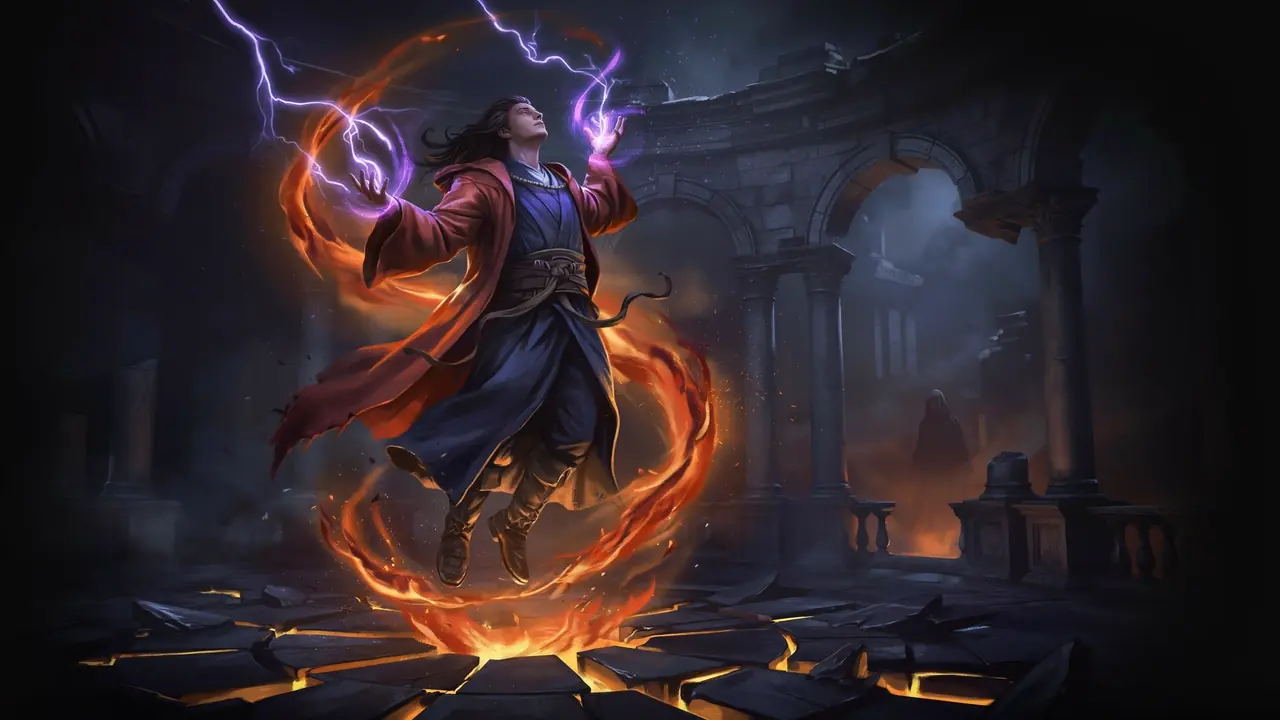
Every other caster earned their magic somehow: study, prayer, a signature on a contract. The sorcerer just has it, the way other people have a temper. That single fact is the whole class. The wizard asks what a spell does; the sorcerer asks what it feels like when it goes off, because it comes from somewhere behind the sternum and it does not always wait to be invited. Played well, a sorcerer is less a spell-slinger than a person managing a live current, and the party can tell.
The concepts that fit are the ones where power is a fact of biology or inheritance rather than a skill. The heir whose family crest turns out to be a portrait of an actual ancestor with wings. The dockhand who sneezed during an argument and set the harbour master's ledger alight. The quiet middle child of a loud family who has spent years suppressing something and is about to stop. Notice what these have in common: the interesting question is never how they got the magic, it's what having it has cost them so far.
The sheet agrees with the fiction. Sorcerers cast from Charisma (force of self, not book-learning) and their skill options run to Persuasion, Deception, Intimidation, and Insight. You are built to be the party's face almost by accident, which is very on-brand for someone whose main qualification is being impossible to ignore.
The choices that matter, level by level
Your origin is decided at level 1: no waiting period, because a bloodline is not something you enrol in. Loreweaver builds the Draconic Bloodline, and its first decision is genuinely flavourful: you pick one of ten dragon ancestors, and that pick fixes an element (red, gold, and brass run to fire; silver and white to cold; blue and bronze to lightning; black and copper to acid; green to poison) that later features will keep coming back to. The bloodline also patches the class's frailty on day one: Draconic Resilience adds a hit point every sorcerer level and sets your unarmoured AC at 13 plus Dexterity: scales under the skin, doing the work armour would.
Level 1 also hands you four cantrips, the most of any caster in the game, against just two levelled spells known. Read that ratio as a design instruction: your at-will magic is broad, your real spells are precious. You learn roughly one new spell per level in the early game, and you do not get to re-pick each morning, so every choice should be a spell you expect to cast fifty times.
Level 2 brings Font of Magic: two sorcery points, back each long rest, which you can trade for spell slots or melt slots down into. Two points is a rounding error; the feature is a seed, not an engine yet. Level 3 is where the class turns on. Metamagic gives you two options from a list of eight, and this is the choice that defines your sorcerer more than any spell: Quickened Spell moves a casting to your bonus action for 2 points, Twinned Spell aims a single-target spell at a second creature, Subtle Spell erases the components so nobody in the room can prove you cast anything, Careful Spell carves your allies out of your own blast radius. You will not add a third option until level 10, so pick the two that describe how your character's magic behaves, not just the two with the best numbers. Level 4 is your first Ability Score Improvement (Charisma, no agonising required), and level 5, as a full caster, opens third-level slots and the heavyweight spells that live there.
Three build sketches
The gilded heir. A half-elf Noble whose great-grandmother's marriage into money was, family legend insists, a marriage into a gold dragon's hoard-line, and the legend just proved literal. Half-elf gives +2 Charisma plus two floating +1s (Constitution and Dexterity, feeding hit points and that 13-plus-Dex AC), and the Noble's History and Persuasion fit someone raised to command a room before they could command fire. Take Subtle Spell and Careful Spell at 3: this is a sorcerer who casts Suggestion mid-negotiation without moving her lips, and whose Burning Hands somehow never singes an ally worth cultivating.
The village firebrand. A dragonborn Folk Hero (red ancestor on both sides of the sheet, since dragonborn already carry a breath weapon and damage resistance keyed to their ancestry) who drove raiders off the mill bridge at fifteen and has been the town's problem-solver since. Fire Bolt and Scorching Ray are the toolkit; Quickened Spell at 3 lets him land a cantrip as a bonus action on the turns the main spell already flew. The long game is level 6, where Elemental Affinity starts adding his Charisma modifier to fire damage rolls: from there, every fire spell he knows quietly hits harder.
The velvet fraud. A tiefling Charlatan who spent years faking magic tricks in market squares (palming coins, rigging candles) before the horrifying afternoon the fire came without the rig. Tieflings bring +2 Charisma and +1 Intelligence plus native fire resistance, and the Charlatan's Deception and Sleight of Hand were her trade before they were her cover. Subtle and Twinned at 3: Charm Person on two marks at once with no gestures to catch is the con she used to only dream about, and Minor Illusion means the old stagecraft never really retired.
Common traps
The first trap is shopping for spells known like a wizard shops for a spellbook. You know a handful of spells, ever (six by level 5), and there is no morning re-pick to bail you out. A situational spell that shines once a month is a wizard's luxury and a sorcerer's dead weight. Choose pillars: a damage line, a control line, an escape hatch like Misty Step. Let the cantrips (you have four!) cover the odd jobs.
The second is treating Flexible Casting as free money. Converting sorcery points into slots and slots into points sounds like an economy; at level 2 you own two points, and the exchange rates are unkind. Early on, sorcery points exist to feed Metamagic, and Metamagic is where the class's identity lives. A sorcerer who liquidates their points for one extra first-level slot has traded the thing only they can do for a thing anyone can do.
The third is Twinned Spell without reading the fine print. Twinning only works on spells that target exactly one creature: it doubles a Charm Person, but it will never double a Fireball or anything with an area. Players pick Twinned for the fantasy of double blasts and discover their blast spells don't qualify. If your known-spells list is all areas and cones, Quickened or Careful will pay you far better.
Taking it past level 5
Past 5, the bloodline keeps its promises. Elemental Affinity at 6 welds your Charisma modifier onto damage rolls of your ancestral element and lets you buy an hour of resistance to it for a single sorcery point: the moment your element stops being flavour and becomes policy. Metamagic deepens on schedule, a third option at 10 and a fourth at 17, while your sorcery point pool grows large enough that Quickening or Twinning stops feeling like spending the rent. Level 14 is the show-stopper: Dragon Wings, a bonus action, flight at your full speed, no duration to track: the ancestry becoming visibly, permanently true. At 18, Draconic Presence lets you spend 5 points to wrap sixty feet of the battlefield in awe or dread, charming or frightening whatever fails to hold its nerve. And the capstone, Sorcerous Restoration, hands back 4 sorcery points on every short rest, the game finally admitting what the character knew at level 1: the fire was never going to run out.