 Loreweaver
✦ Guides
Session zero characters: building a party, not four strangers
Updated: 2026-07-22
Why characters made alone come out wrong
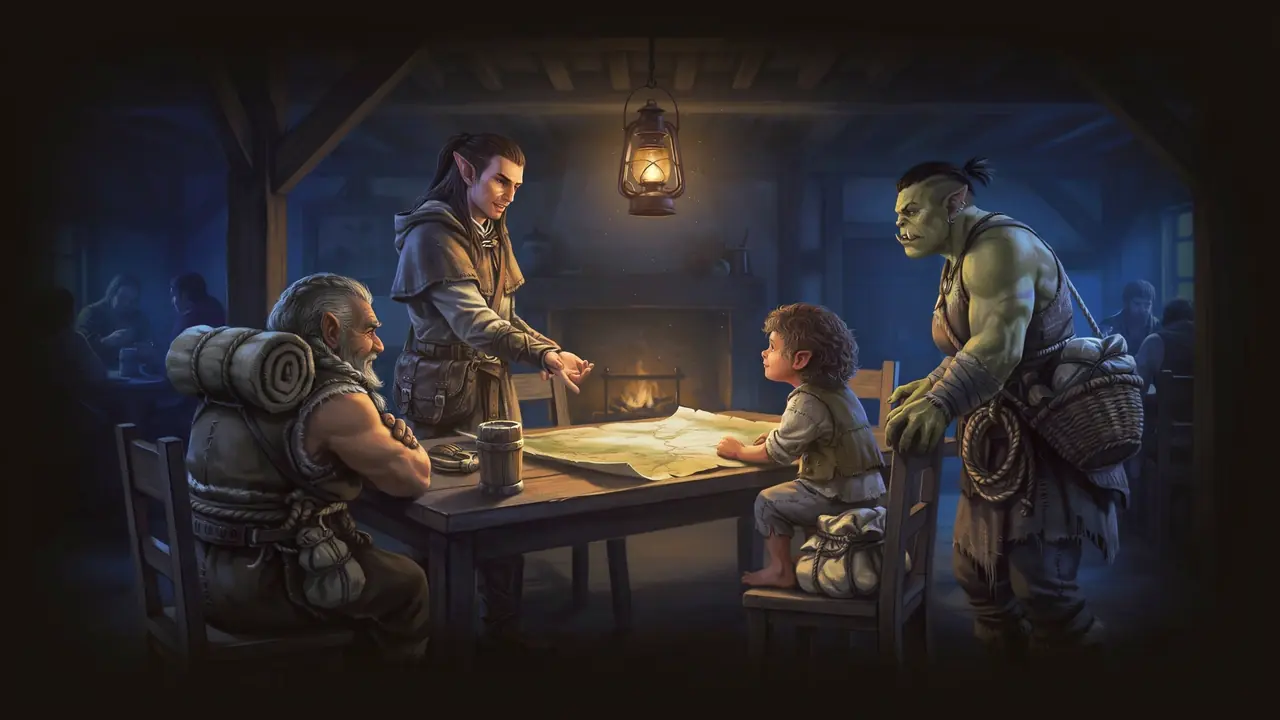
Most disappointing parties were built the same way: four players, four separate evenings, four characters designed in a vacuum, all meeting for the first time in a tavern that none of them has a reason to stay in. Each character might be excellent alone. Together they are strangers with no shared history, no reason to trust each other, and, if the dice of independent creation fell badly, three loners "who work alone" and nobody who can heal.
Session zero exists to prevent exactly this. It is the session before the campaign where the table makes characters together, in the same room or the same call, out loud. The point is not efficiency. The point is that a party is a thing you design, the fifth character at the table, and it can only be designed collectively. An hour of coordinated creation buys months of a party that actually functions as one.
None of this requires anyone to compromise their concept into mush. It requires sequencing: share the concepts before anyone finalises anything, and let the ideas bend toward each other while they are still soft.
Start with the campaign's shape, not your character
Before any concept gets pitched, the DM should say what the campaign actually is: the tone (grim, swashbuckling, political), the setting's texture, roughly how much combat versus intrigue versus exploration, and any hard lines. This is not flavour text; it is load-bearing. A brooding revenge tragedy of a character is a wonderful concept and a miserable fit for a lighthearted heist campaign, and the player deserves to know that before falling in love with the idea.
The most useful thing a DM can offer here is the premise question: why is this group together, and what do they want? Some tables answer it up front ("you all work for the same courier company", "you grew up in the same drowned village"). A shared premise is worth more than any individual backstory, because it answers the question that kills more campaigns than any dragon: why don't these people just walk away from each other?
Players, meanwhile, should arrive at session zero with a sketch, not a statue. One sentence of concept and a feeling about the mechanics is plenty. Everything you have not yet committed to is room to fit the party; everything you have already locked is a wall the other three have to build around.
Niche overlap: the quiet party killer
Every character wants a niche: the thing the table looks to them for. Trouble arrives when two players independently claim the same one. Two stealthy infiltrators means every infiltration scene has an understudy; two silver-tongued faces means one of them is always second choice in the conversation they built their character to lead. Neither player did anything wrong. They just never compared notes.
The fix at session zero is a simple sweep across the party's jobs: who is hard to kill, who deals the damage, who patches wounds, who talks, who sneaks, who knows things. Not every seat needs filling (parties survive without a dedicated healer far more often than new tables believe), but every seat should be claimed on purpose or left empty on purpose. Surprise vacancies are fine; surprise duplicates fester.
When two concepts do collide, resist the reflex that one player must fold. Overlap can be differentiated instead: two sneaks become the cat burglar and the assassin, two faces become the honeyed diplomat and the barefaced liar, and the pair becomes a feature of the party instead of a rivalry between players. Shared niches only fail when they are identical and unacknowledged.
- Sweep the roles out loud: durability, damage, healing, talking, sneaking, knowing.
- Leave gaps deliberately if the table likes the risk; never leave them accidentally.
- Differentiate overlapping concepts instead of vetoing one of them.
Backstory the DM can actually use
A backstory is not a biography; it is a box of hooks you are handing the DM. The five-page tragic history that resolves everything before session one gives the DM nothing to grab. The half-page with three live wires (a person who matters, a debt or wound that is still open, and a want the character would take risks for) gives the DM three episodes of your personal spotlight, pre-approved by you.
The strongest hooks are unresolved and specific. "My sister vanished with the caravan she was guarding, and the company that hired her says the caravan never existed" is an adventure the DM can schedule. "My family died and I am sad" is a mood. Write the names down: a named rival, a named mentor, a named creditor. Named people can walk through the door in session six, and a good DM will make sure they do.
Best of all are hooks that braid characters together. At session zero, offer connections: my smuggler could have run cargo for your merchant; your temple might have raised my orphan. Two or three pre-existing pairwise ties turn the awkward tavern scene into a reunion, and they give every player a reason to care about someone else's spotlight episode, because their own character is stitched into it.
A session zero checklist that fits on a napkin
If your table only has an hour, spend it in this order. First, the DM pitches the campaign's tone and premise, and the table agrees on lines and expectations. Second, everyone pitches their one-sentence concept and the group listens for clashes of tone and collisions of niche. Third, the role sweep: claim jobs, differentiate overlaps, bless the gaps. Fourth, connections: every character leaves with at least one tie to another character and at least one open hook for the DM. Only then does anyone touch a sheet.
Notice what the hour was spent on: not rules, not shopping, not ability scores. Those are solo homework and they are easy once the concept is fixed. The things that can only happen with everyone present (tone agreement, niche negotiation, shared history) are what the meeting is for.
And keep a little unfinished. A character who arrives at session one with every question answered has nowhere to grow, and a party that knows everything about each other has nothing to discover. The best session zero output is four characters who fit together like strangers who might become family: compatible, connected, and still mostly unwritten.